_(cropped)).jpg)
Projects
In this section you will find information on projects that deal with events, their effects and their historical background all related to the First World War. Click here to go to the projects
The war can be worked on in almost any community, starting at the memorial on the square. What matters is the scope, not the subject.
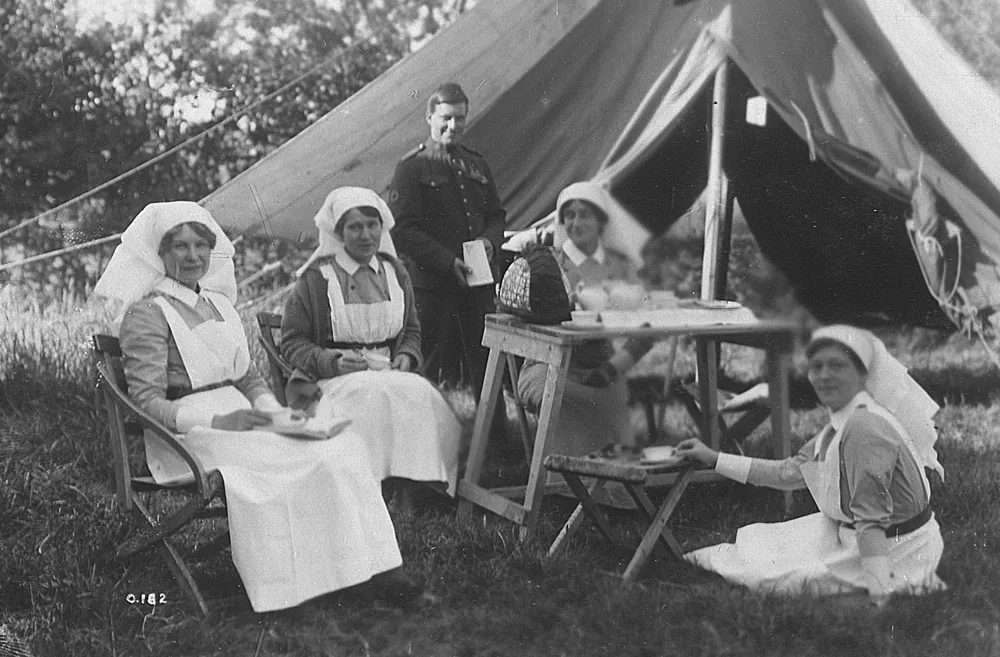
The most effective form of teaching this subject is not the survey lecture but the group’s own research. The reason is simple: someone who finds a name in a parish register has had an experience no text supplies.
Three project types have become established. Local historical research starts at the memorial or the war graves plot of the group’s own town and works through archive sources towards individual lives. International encounters – work camps and youth exchanges at war cemeteries – combine practical work at the site with shared historical study; participants usually come from countries that were on opposite sides in 1914. Competitions provide a framework and an audience beyond the school.
A result that did not exist before. A list of names, an exhibition panel, a contribution to a commemoration, a restored grave plot. The difference from an essay is that something is made and stays.
A narrow subject. „The First World War in our town" is too large. „The twelve names on the memorial by the church" is the right size – and goes further, because twelve names can actually be worked on.
An archive visit rather than an internet search. The moment someone deciphers 1915 handwriting in a parish register and finds the name is not replaceable. Small archives need appointments, but almost always help willingly.
An addressee. Working for the community, for the school public or for the archive is different from working for a mark. Handing the results to the local archive at the end is part of the project, not an afterthought.
In this section you will find information on projects that deal with events, their effects and their historical background all related to the First World War. Click here to go to the projects
In this section you will find information on projects and useful facts from the areas of education and museum proposals. Click here to go to the education and museum proposals section
Source criticism deserves a place in every project. Three questions do most of the work: who wrote or photographed this, and when? For whom was it intended? What is missing – censorship gaps, struck-out lines, omissions? These can be taught at any age and turn collecting material into historical work.
One further point on age. From lower secondary the full range works: the alliance system, trench warfare, the home front, the consequences. Below that a narrow, concrete approach is better – one memorial, one letter, one photograph – with the leading question being how people lived rather than how many died. In the sixth form the subject becomes something else again: historiography and the conflicts over interpretation, from the war guilt clause of 1919 through the Fischer controversy to the centenary debates. At that level the war connects to everything that followed.
For three to five names including an archive visit, four to six double lessons spread over a term is realistic. Depth matters more than number: one life properly documented carries further than twenty merely listed.
For most projects the town or parish archive and the digitised casualty lists are enough. Only once a unit is known does a state or federal archive become worthwhile. A telephone call beforehand saves time, since many small archives open only on set days.
Yes. Maintenance work, documentation and work camps at war cemeteries are an established format both at home and abroad. Organisation runs through the responsible bodies, with several months’ lead time.
From lower secondary for the full range. With younger classes a narrow, concrete approach works better – one memorial, one letter, one photograph – leaving aside casualty figures and the course of battles.