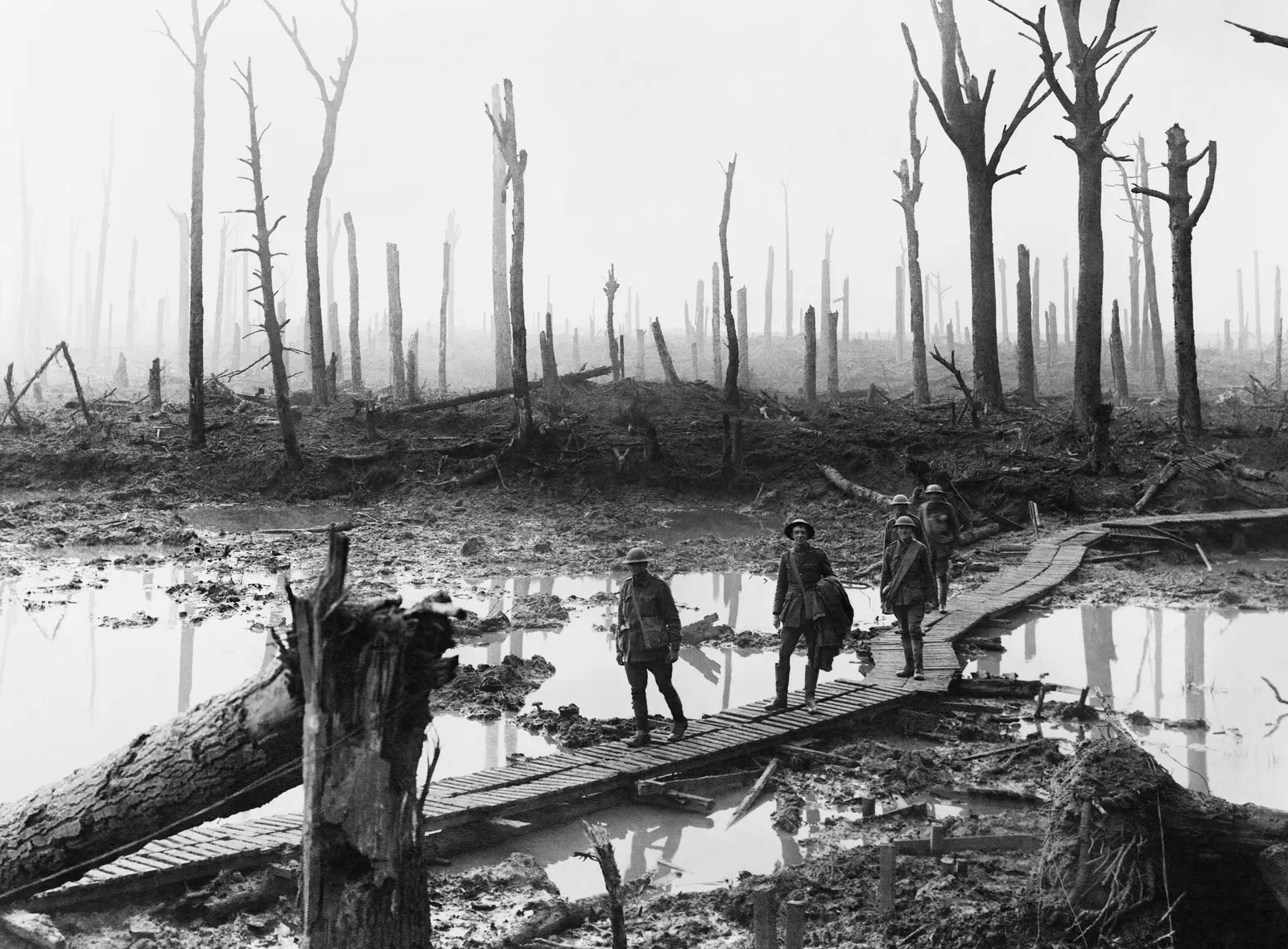
The abundance is a centenary effect. Between 2014 and 2018 considerable funding went into digitisation across Europe; archives opened holdings that had previously been consultable only on site, and several countries built national portals. Much of it is still online and still usable.
A distinction by type helps. Archive portals give access to original records and take some practice. Editorial portals provide context and are the right place to begin. Databases – casualty lists, grave registers, unit records – answer specific questions about individuals. Teaching resources supply material prepared for classroom use.
The three that matter most are international rather than national. 1914-1918-online is a peer-reviewed encyclopaedia, freely accessible, written by an international body of historians. Europeana 1914–1918 brings together digitised library holdings with objects contributed by private individuals at collection days. The European Film Gateway opens up film material from several national archives.
The order in which to search
First, secure what is known. Name in its contemporary spelling, year and place of birth, place of residence, last known address – and anything apparently trivial, such as a field post number on the edge of a card.
Second, establish the unit. It is the key to everything else. Clues come from field post senders, shoulder straps in photographs, service papers and the digitised casualty lists.
Third, determine the sector of the front. Regimental histories and war diaries show where a unit stood and when.
Fourth, search for the grave. Only now do the grave registers become useful, because date of death and sector narrow the results.
One caveat applies throughout: the record is unevenly preserved. Personnel files for Commonwealth, Canadian, Australian and French soldiers are largely digitised and freely accessible. For German soldiers almost everything depends on which state recruited them – Bavarian, Saxon and Württemberg records survive; the Prussian army archive largely burned in 1945.
Listed resources
1914-1918-online.net: International encyclopaedia of the First World War (in English)
In this project based at the Free University of Berlin, academics from various countries have compiled a comprehensive encyclopaedia. The individual articles are to be linked to one another. The aim is to fill in the existing gaps in research. Publication is planned for 2014.
Europeana 1914-1918
An online archive of materials on the First World War from throughout Europe. Private individuals and institutions from Europe are invited to contribute letters from the front, diaries, photos and pictures of objects from the time of the First World War with explanations. The accurate search function makes it possible, for example, to search for material from your home town or about particular sections of the front.
Europeana Collections 1914-1918 (in English)
Digital collection on the First World War. The material comes from ten European libraries (including the Berlin State Library und Clio online aus Deutschland).
EFG 1914 (in english)
The website of an international project containing films and other material on the First World War. 21 European film archives are involved, alongside other partners. 661 hours of film and 5600 documentary films are to be digitalised and made available via the portal. The integration of the Google translator at the foot of the website means that the contents can mostly be rendered in German too.
La Grand Guerre
"La Grande Guerre" is a blog of the research group at the German Historical Institute Paris (DHI Paris). It contains information about events and activities of the research focus "First World War" and the research group "Political Cultural History of the Pre-War Period 1900–1914" of the DHI Paris.As well as the latest research standpoints and information on events, networking amongst the members of the research group and discussion amongst the participants of events is promoted in this way. Under menu items such as Events, Lectures/Readings, News and Sources Online, anyone can find out about the current state of research and events, or exchange ideas with other interested parties on the platform.There is also the option of regularly keeping up-to-date with news via newsletters.
Museum Network - Réseau des Musées
The Museum Network is an association of museums from France, Germany and Switzerland that collaborate on the basis of projects. Roughly every four years, the Network presents exhibitions on a common umbrella topic in each of the participating museums. The core area of the Network is the Upper Rhine region, but museums from neighbouring regions are also able to participate. The 2014 Museum Network is presenting over 20 individual exhibitions on the First World War in Alsace, Baden, the Palatinate and North-West Switzerland. The exhibitions will illuminate the epoch-making event from a French, Swiss and German perspective. The conceptually coordinated exhibitions will address various content-based and regional aspects at the same time. This will enable the partners to offer visitors a comprehensive view of the time 100 years ago.All exhibitions are available free of charge with a museum pass. Program of events
14 – Diaries of the First World War
In 2014, the outbreak of the First World War reaches its 100th anniversary.In honor of this occasion, “ARTE” and “Das Erste” present the multi-part television production and multimedia web special “14 – Diaries of the First World War”. On television and online from the 29 April, this key topic examines the largest war ever seen up to that point – for the first time from a multi-national perspective and from the viewpoint of people who experienced it. For more detailed information, please take a look at the homepage, which is linked in the heading. You can find out the broadcast dates of each individual film part from our events calendar.
Web addresses change, and many of these projects were funded only for the centenary. Searching for the project name rather than the address usually works, and the Internet Archive preserves earlier versions of many of these sites.
Frequently asked questions
Where do I start if I know nothing?
With 1914-1918-online for factual questions and with the dossiers of a national broadcaster or civic education body for orientation. Archive portals and databases are the second step, once a specific question exists – without one, the search terms are missing.
Are casualty lists available online?
Yes. The German casualty lists of the First World War are largely digitised and searchable, giving name, rank, unit and place of origin. France maintains a national database of the Morts pour la France, and the Commonwealth War Graves Commission records Commonwealth casualties with their grave or memorial.
Are these resources free?
Portals run by archives, museums, universities and public bodies are generally free and need no registration. Commercial genealogy services and some newspaper archives are partly paywalled; many public libraries hold licences that can be used with a library card.
How reliable are online resources on this subject?
Material from archives, museums, universities and public broadcasters is generally reliable because it cites its sources. Private collectors’ sites often hold valuable material found nowhere else but frequently without provenance; misattributed photographs are the commonest error there.